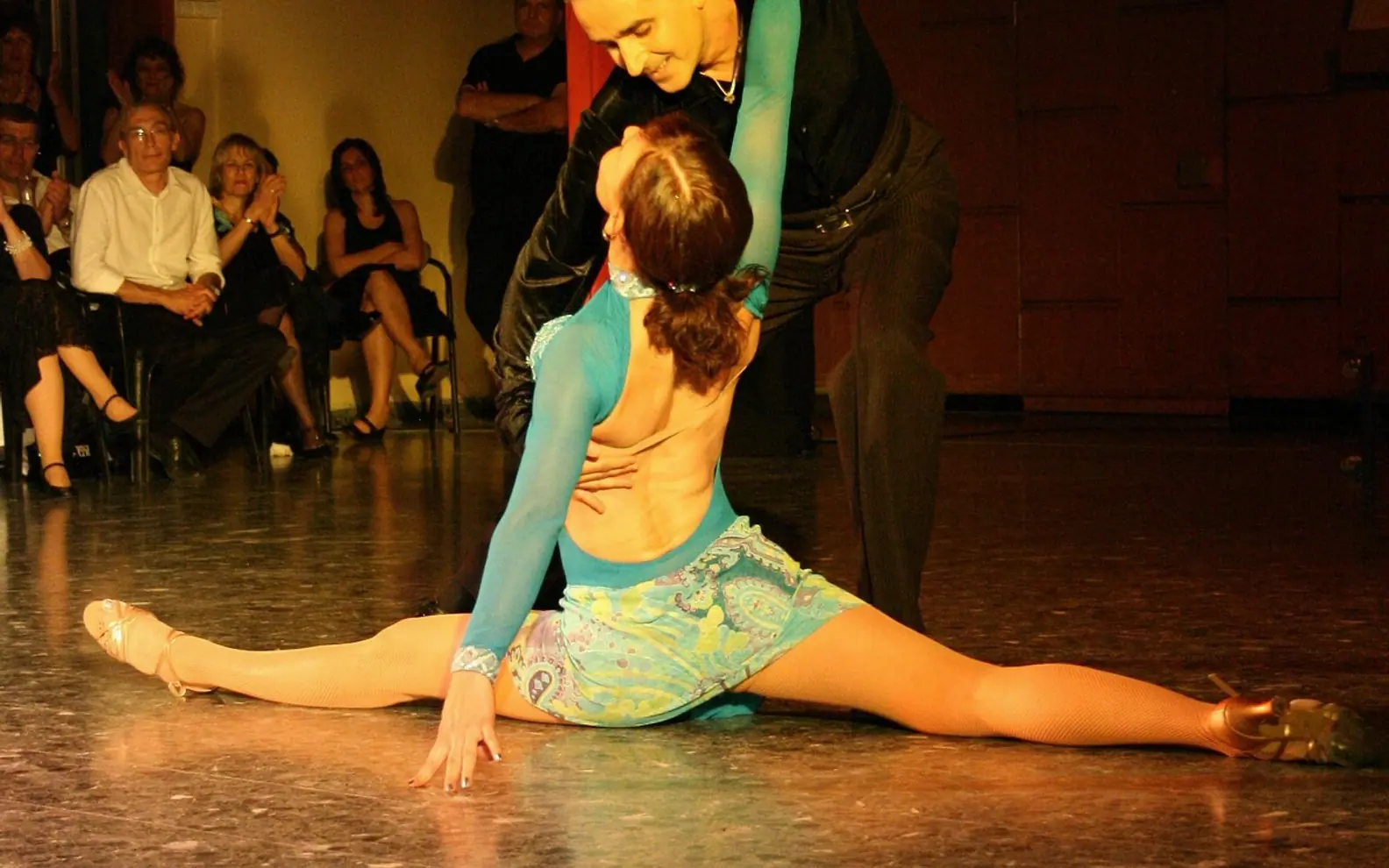
The main difference between salsa and bachata is the rhythm and the direction of travel. Salsa is usually faster, with a forward-and-back basic step, lots of turns and a pause on counts four and eight. Bachata is usually slower and smoother, moves side to side and marks every fourth count with a small tap or hip accent. Salsa grew out of Cuban and Puerto Rican music in New York; bachata comes from the Dominican Republic and its guitar-led songs.
At a glance
| Salsa | Bachata | |
|---|---|---|
| Roots | Caribbean styles such as Cuban son and mambo, shaped in New York | Dominican countryside guitar music |
| Sound | Congas, timbales, bongos, piano patterns, brass | Lead and rhythm guitars, bass, bongos, güira scraper |
| Pace | Generally quick and bright | Generally moderate and rolling |
| Basic step | Forward and back, three steps then a pause | Side to side, three steps then a tap |
| Hold | Open, room for many turns | Often closer, more body connection |
| Feel | Energetic, playful, spinning | Smooth, flowing, romantic or playful |
The rhythm: counting each dance
Both dances count music in groups of eight, which is why practising the count matters so much. If finding the first beat still feels hit and miss, our guide on how to find the beat in music breaks it down.
Salsa: quick, quick, slow
Dancers step on 1, 2, 3, hold on 4, then step on 5, 6, 7 and hold on 8. The common "on 1" style breaks forward on the first beat. The "on 2" style, often linked with New York mambo, places the break on the second beat and feels smoother to many dancers. Cuban salsa, known as casino, keeps the couple circling around each other rather than dancing in a straight line.
Bachata: step, step, step, tap
Dancers step on 1, 2, 3 and add a tap or a small hip lift on 4, then repeat on 5, 6, 7 with the accent on 8. That fourth-count accent is the signature of the dance and tells you instantly you are not doing salsa.
The basic steps
These are described from the leader's side; the follower mirrors them, starting on the opposite foot.
Salsa basic (on 1)
- Count 1: step forward with the left foot.
- Count 2: shift weight back onto the right foot in place.
- Count 3: bring the left foot back beside the right.
- Count 4: pause.
- Count 5: step back with the right foot.
- Count 6: shift weight forward onto the left foot.
- Count 7: bring the right foot back beside the left.
- Count 8: pause.
Bachata basic
- Counts 1–3: step left, bring the right foot to meet it, step left again.
- Count 4: tap the right foot beside the left, letting the hip lift slightly.
- Counts 5–7: step right, close left, step right.
- Count 8: tap the left foot and return.
Keep steps small in both dances. Big strides make you late and pull a partner off balance.
How the styles feel on the floor
Salsa rewards quick feet and clean turning technique. Partners often separate into open position, and the leader sends the follower into spins and patterns. Shines, solo footwork sequences, give each dancer a moment to play.
Bachata tends to feel more connected. Traditional Dominican bachata is light and full of quick footwork and syncopation, while sensual bachata, which developed later in Spain, adds body waves, rolls and slower, flowing shapes. Many social dancers mix elements of both.
Which should a beginner learn first?
There is no wrong answer, but a few points may help you choose:
- Bachata has a basic step many beginners pick up within a single lesson, and the moderate pace gives you time to think.
- Salsa takes longer to feel comfortable at full speed, but its turns and partnerwork build skills that carry over to other dances.
- Your music taste is the best guide. You will practise more if you love the songs.
Plenty of people learn both side by side, since social nights frequently play salsa, bachata and sometimes merengue in the same evening. You can drill both basics alone in a cleared corner before attending a class; our guide on how to learn to dance at home covers setting up a safe practice space.
Common beginner mistakes
- Looking down at the feet instead of keeping the head up and the frame relaxed.
- Stepping on every beat in salsa instead of pausing on 4 and 8.
- Forgetting the tap in bachata, which turns it into an aimless sway.
- Gripping a partner's hand tightly rather than keeping a light, responsive connection.
- Copying advanced dips and tricks from videos before the basics are steady.
Quick questions
Can you dance bachata to salsa music?
Not comfortably. The rhythms are built differently, so the accents fall in the wrong places. It is better to match the dance to the song.
Do I need a partner to start?
No. Basic steps, timing and body movement can all be practised solo. Partner skills come in class or at social dances.
Which dance is better for a slower song at a party?
Bachata usually suits mellow, romantic tracks. For a simple sway that works with almost any ballad, see our guide on how to slow dance.